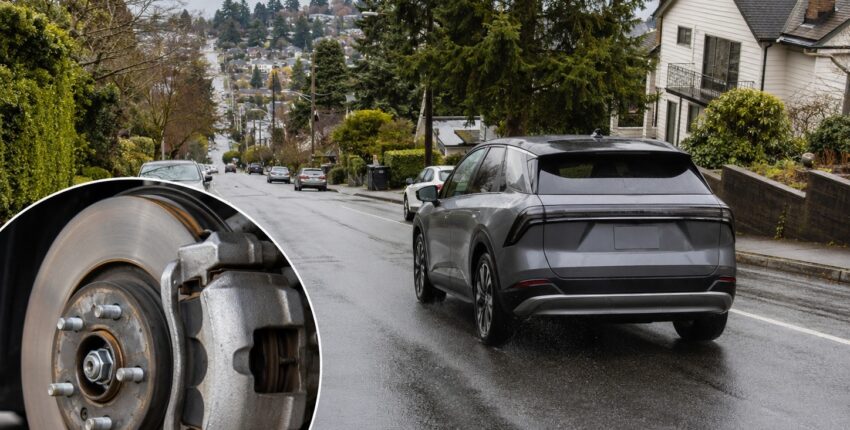
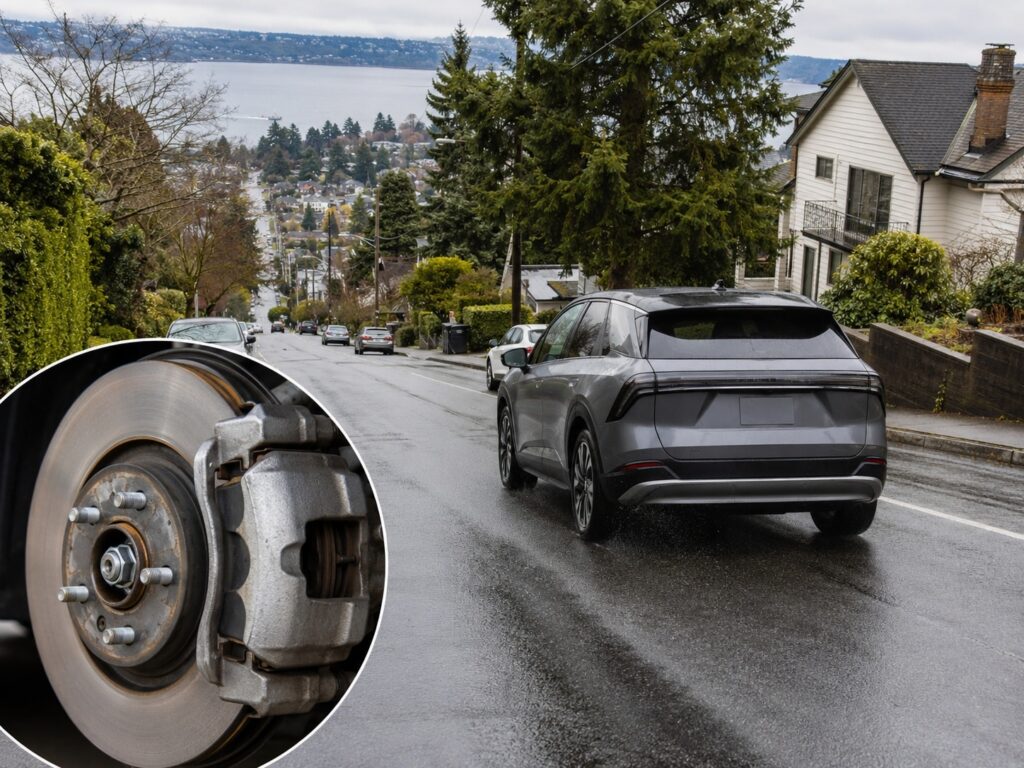
One of the best things about driving a hybrid or electric vehicle around Magnolia is regenerative braking.
Lift off the accelerator or press the brake pedal, and the electric motor can help slow the vehicle while putting energy back into the battery.
That means less energy gets wasted as heat.
It can also mean something owners don’t always expect:
The conventional friction brakes may be used less often than they are on a gasoline vehicle.
That’s great for brake-pad life.
It isn’t always great for everything else in the braking system.
On a vehicle that spends much of its time using regenerative braking, the pads can still look surprisingly healthy while the rotors develop corrosion, or brake hardware begins needing attention.
For drivers dealing with Magnolia’s hills, wet weather, and frequent low-speed driving, brake condition deserves more attention than pad thickness alone.
Your hybrid or EV still has conventional brakes
Regenerative braking doesn’t eliminate the normal braking system.
Hybrids and EVs still use conventional friction brakes with components such as:
- Brake rotors
- Brake pads
- Calipers
- Caliper slide hardware
- Brake fluid
- Parking-brake components
What changes is how often those components may be asked to slow the vehicle during normal driving.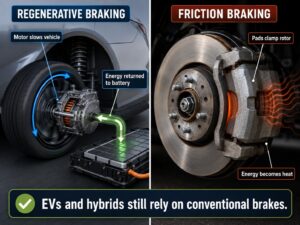
Regenerative braking uses the electric motor to help decelerate the vehicle while recovering energy for the high-voltage battery. Hyundai, for example, describes its regenerative system as using the electric motor to slow the vehicle and convert that motion into electrical energy.
Depending on the vehicle, battery state, temperature, speed, braking demand, and operating conditions, the friction brakes still step in when needed.
But during a lot of everyday driving, regeneration can do a substantial share of the work.
Less brake wear can create a different brake problem
For decades, one of the most common reasons to service brakes was straightforward:
The pads wore down.
Regenerative braking changes that equation.
If the friction brakes are being used less, brake pads can last much longer.
But rotors and caliper hardware don’t necessarily benefit from sitting around.
Brake rotors are bare metal surfaces. Moisture can create light surface rust surprisingly quickly. Normally, applying the friction brakes helps sweep that material from the rotor surface and generates heat that helps dry the assembly.
When regenerative braking handles much of the slowing, the friction brakes may see less frequent use.
Tesla has specifically explained that EVs rely heavily on regenerative braking, causing the friction brake assemblies to be used less and produce less heat. Tesla notes that this can mean accumulated moisture takes longer to dry from the friction brakes.
Hyundai’s current EV documentation makes the point even more directly: some models include a Brake Disc Cleaning mode that temporarily limits regenerative braking and intentionally uses the friction brakes to help reduce rotor rust and brake noise.
That’s a pretty good indication that brake corrosion on lightly used EV friction brakes is a real engineering consideration.
Magnolia weather adds another ingredient: moisture
Now put that braking system in Seattle.
The vehicle gets wet.
It sits outside.
The rotors develop a light layer of surface oxidation.
Then the driver leaves the house and uses regenerative braking for much of the trip.
Instead of immediately putting the friction brakes through repeated normal applications, the vehicle may use the electric motor for a meaningful portion of the deceleration.
That doesn’t mean every hybrid or EV in Magnolia is developing rusty brakes.
It means low friction-brake use and persistent moisture can create a different maintenance pattern than owners may be accustomed to.
What Magnolia’s hills change
Magnolia’s geography makes regenerative braking especially useful.
Routes through the neighborhood include repeated descents, climbs, intersections, and speed changes. Magnolia Boulevard follows the neighborhood’s bluff terrain, and W Dravus Street is one of the important routes connecting Magnolia with the rest of Seattle. The City of Seattle itself notes the city’s challenging steep-slope topography, while Seattle Parks describes Magnolia Boulevard along the neighborhood’s bluff landscape.
On an EV or hybrid, descending a hill is exactly the type of situation where regenerative braking can recover energy instead of converting all of that vehicle motion into heat at the brake rotors.
Some manufacturers even recommend increasing regenerative braking on long or steep descents to reduce reliance on the friction brakes.
That’s excellent technology.
It just means the brake inspection has to look beyond:
“How thick are the pads?”
Pads can look good while the rest of the brakes need attention
This is one of the biggest differences owners should understand.
A conventional brake inspection shouldn’t stop at measuring remaining pad material.
On a hybrid or EV, we also want to know what’s happening with:
- Rotor surfaces
- Inside and outside pad condition
- Caliper movement
- Caliper slide pins and hardware
- Parking-brake operation
- Brake fluid condition
- Uneven corrosion or wear
- Brake noise or vibration
- Vehicle-specific brake-service requirements
You can have plenty of friction material left on the brake pads and still have a brake system that deserves service.
That’s why “my pads still have tons of life” doesn’t necessarily tell us the condition of the complete braking system.
What about seized calipers?
This needs a little nuance.
Regenerative braking doesn’t directly cause a brake caliper to seize.
The concern is that less frequent friction-brake movement combined with moisture, corrosion, age, and environmental exposure can allow brake hardware problems to develop without the obvious pad wear owners normally associate with brake service.
Depending on the brake design, that can involve corrosion or restricted movement around slide pins, pad contact points, caliper components, or parking-brake mechanisms.
Tesla’s current service documentation includes procedures for cleaning and lubricating brake calipers and explicitly includes corrosion removal where appropriate.
So the better message isn’t:
“Regen makes calipers seize.”
It’s:
“Low friction-brake use can allow corrosion and hardware problems to matter even when the pads still look nearly new.”
“But my EV barely uses the brakes”
Exactly.
That’s why inspecting them matters.
The normal warning sign on a gasoline car used to be:
“My brake pads are wearing out.”
On some hybrids and EVs, the maintenance question can become:
“My pads aren’t wearing very much — but what condition is everything around them in?”
Those are two different problems.
Regenerative braking isn’t always available either
Another reason conventional brakes still matter is that regeneration has operating limits.
Depending on the vehicle, regenerative braking may be reduced because of:
- High battery state of charge
- Very high or low battery temperature
- ABS or stability-control intervention
- Vehicle speed
- Driving mode
- System limitations
Hyundai’s current documentation, for example, states that regenerative braking can be temporarily limited when the high-voltage battery is fully charged or when battery temperature is too high or too low. In those situations, hydraulic braking remains available.
Your friction brakes are still the vehicle’s braking system.
They need to be ready when they’re called upon.
What we look at during a hybrid or EV brake inspection
At 34th Street Garage, the point isn’t to replace brake parts just because the vehicle is electric or hybrid.
The goal is to determine what condition the braking system is actually in.
A brake inspection may include checking:
- Brake pad thickness and condition
- Rotor condition and corrosion
- Uneven contact patterns
- Caliper and slide movement
- Brake hardware
- Parking-brake operation where applicable
- Brake fluid condition
- Noise, pulsation, dragging, or other symptoms
What needs attention depends on what we find.
Some vehicles may need nothing.
Others may benefit from cleaning, lubrication, or brake service before corrosion creates a bigger problem.
And if pads or rotors actually require replacement, that decision should come from inspection and measurement—not simply from the vehicle being an EV.
The takeaway for Magnolia hybrid and EV owners
Regenerative braking is one of the reasons hybrids and EVs are so efficient.
It can also dramatically reduce conventional brake-pad wear.
But less wear does not mean no maintenance.
In a wet Seattle environment, a brake system that sees less friction-brake use can develop rotor corrosion and hardware issues while the pads themselves still appear to have plenty of life remaining.
So if you drive a hybrid or EV around Magnolia’s hills, don’t judge your brakes only by how many miles are on the vehicle—or how thick the pads look.
Have the complete braking system inspected.
Not sure what condition your hybrid or EV brakes are in?
Call 34th Street Garage at 206-283-3448 or schedule through the current online appointment booking system.
We’ll inspect the braking system, explain what we find, and help you determine what needs attention now and what can be monitored.