
A vehicle that occasionally sputters and shuts off at a red light can be frustrating because the problem may disappear as quickly as it appeared.
That was the complaint with this 2016 BMW X1 xDrive28i. The BMW would sometimes sputter while stopped, shut off, and then restart normally after the driver shifted into Park.
There was another interesting detail.
The check engine light was not illuminated.
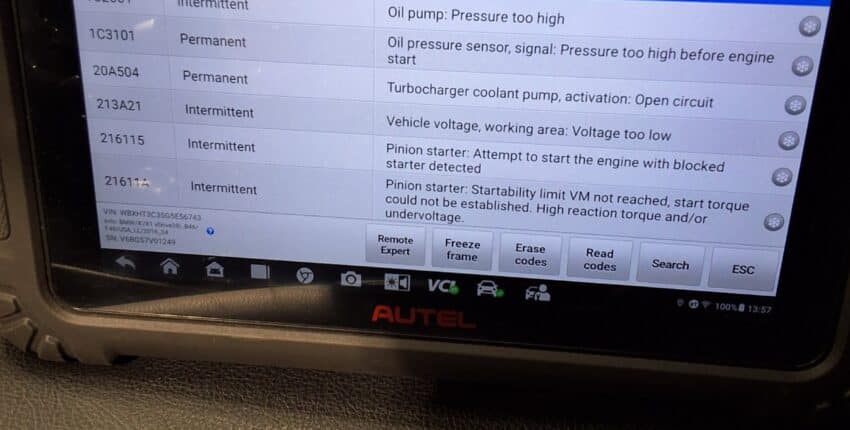
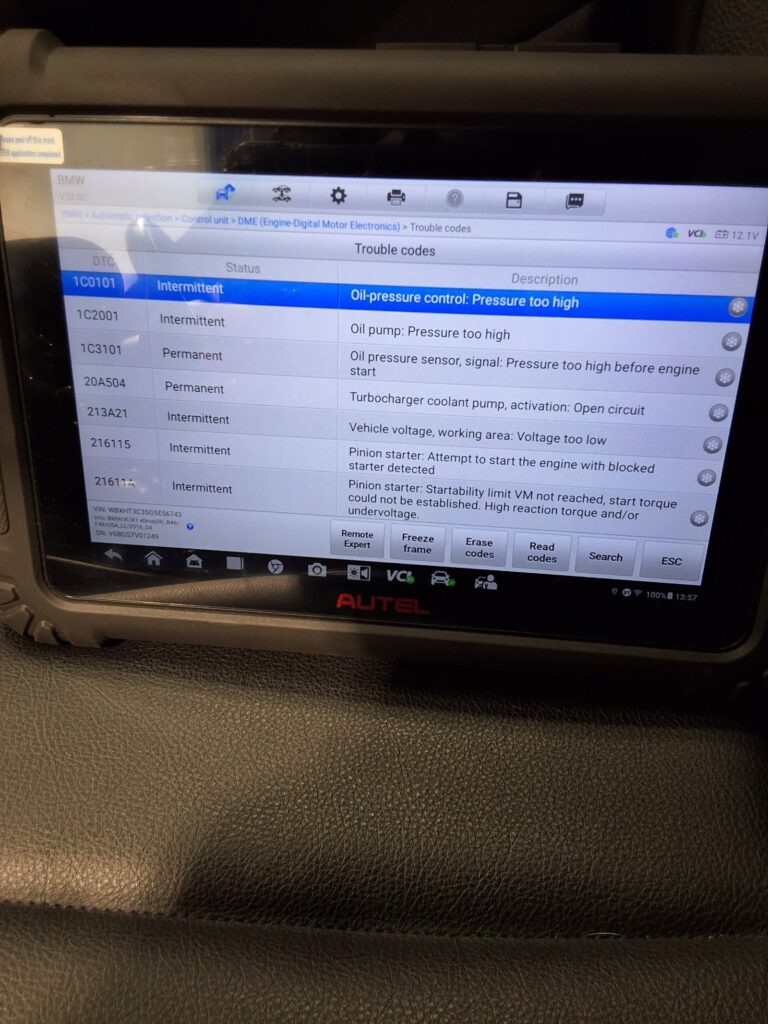
That did not mean the BMW had nothing stored in its computers. Diagnostic testing found three separate faults that gave the technician several places to investigate.
No Check Engine Light Did Not Mean No Stored Faults
The BMW had three stored faults even though the check engine light was not on during the visit.
One involved the oil pressure sensor signal. Another involved the electric coolant pump for the turbocharger cooling circuit, and the third involved low vehicle voltage.
That is an important distinction for drivers.
A warning light is one way a vehicle communicates a problem, but the absence of an illuminated check engine light does not guarantee that every monitored system is operating normally or that no diagnostic information has been stored.
The next step was to determine what the stored information actually meant.
The Oil Pressure Reading Did Not Make Sense
One fault involved the oil pressure sensor signal.
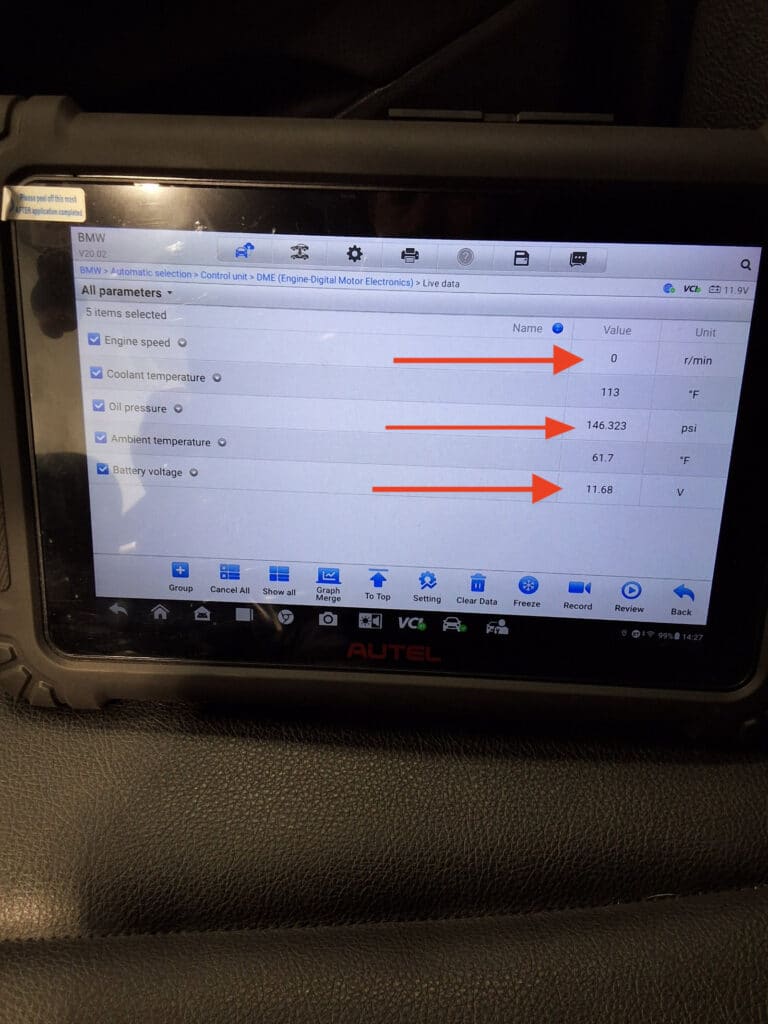
With the key on and the engine not running, the technician looked at live data and saw an oil pressure reading of approximately 146 psi. The reading then stayed very close to the same value with the engine idling.
That information did not fit the actual operating conditions.
The engine was not even running when the unusually high pressure reading first appeared, so the technician had good reason to question the signal being reported by the oil pressure sensor.
The oil pressure sensor was replaced as part of the completed repair.
This is a good example of why diagnostic data has to be interpreted rather than simply read from a screen. A number from a scan tool becomes useful when the technician compares it with what the vehicle is actually doing.
A Second Fault Pointed Toward the Electric Coolant Pump
Another stored fault involved the turbocharger coolant pump circuit.
The technician attempted to activate the pump with the scan tool. The pump did not respond.
That gave the technician more than a stored code to work with.
The computer had recorded a circuit fault, and the component also failed to respond when it was commanded during testing.
The electric auxiliary water pump was replaced, and the cooling system was serviced with the proper BMW-compatible coolant as part of the completed work.
We should not automatically assume that this pump failure caused every sputter or shutdown the driver experienced.
What we can say is that the fault was present, the pump did not respond during testing, and the failed component was repaired.
The Third Fault Was Low Vehicle Voltage
The BMW also had stored information showing that vehicle voltage had dropped below the level expected from a healthy battery.
Freeze-frame information showed approximately 11.78 volts and, at another point, about 10.83 volts.
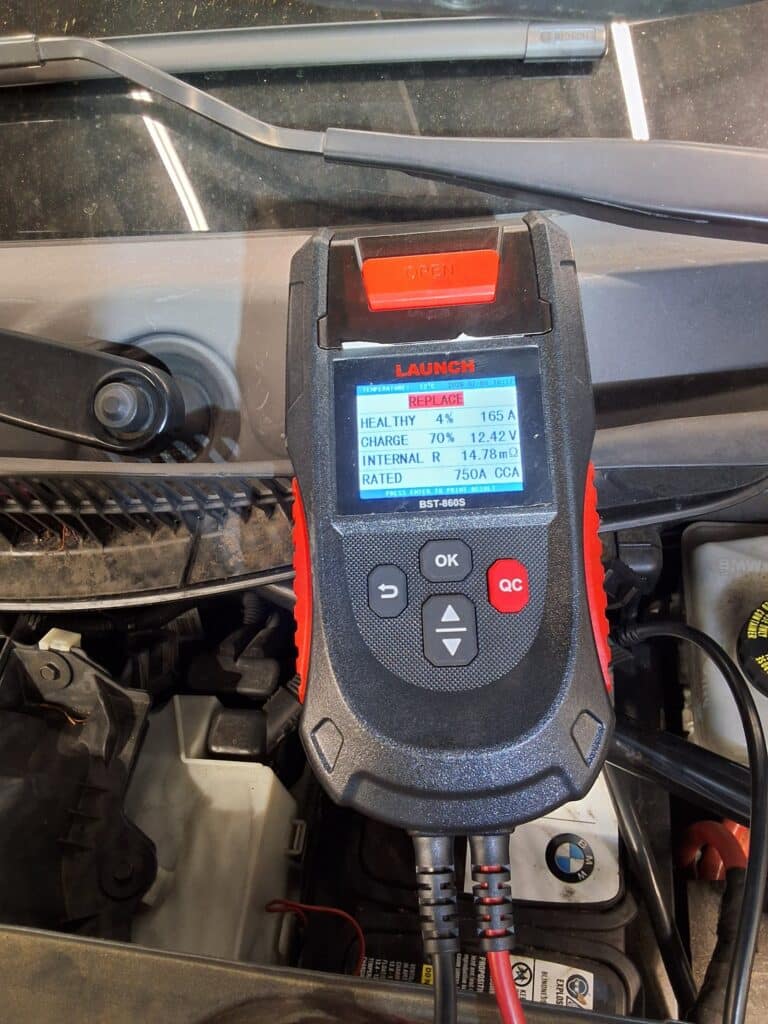
The battery was then tested separately and failed.
An AGM battery was installed and the system was rechecked.
Stable electrical voltage matters on a modern BMW because computers, sensors, pumps and control modules all depend on a reliable electrical supply. That does not mean we should blame every symptom on the battery, but a battery that fails testing is a confirmed problem that should not be ignored.
Three Faults Did Not Automatically Mean One Cause
At this point, the BMW had three confirmed areas needing attention.
The oil pressure signal was not behaving normally. The electric coolant pump would not respond when commanded, and the battery had failed testing after low-voltage data had been stored.
All three problems deserved repair.
What the repair record does not establish is that one specific component was proven to be the single cause of every intermittent sputter or red-light shutdown.
That distinction matters.
A vehicle can have more than one problem at the same time. Good diagnostic work identifies and repairs what the evidence supports, then verifies operation rather than forcing every finding into one convenient explanation.
What Is Freeze-Frame Data?
Freeze-frame data is information the vehicle computer can capture around the time a fault is recorded.
Depending on the system and vehicle, that information may include voltage, engine speed, temperature, operating load or other conditions that help a technician understand what was happening when the problem occurred.
On this BMW, stored voltage information helped show that system voltage had dropped unusually low.
That did not replace battery testing.
It gave the technician another piece of evidence, and the battery test then confirmed that the battery itself needed replacement.
Live Data Can Be Just as Important
Live data allows the technician to see what sensors and control systems are reporting while the vehicle is being tested.
In this case, the oil pressure signal was especially useful because it showed an unusually high reading with the key on before the engine had even started.
The value stayed nearly unchanged after the engine was running.
The important part was not simply seeing a number on the screen.
The useful part was recognizing that the number did not match the vehicle’s actual operating condition.
That is why diagnostic equipment is only as useful as the testing and interpretation that go with it.
Sometimes the Dashboard Does Not Tell the Whole Story
Drivers naturally look at the dashboard for clues.
If the check engine light is not on, it is easy to assume the engine computer has nothing useful to report.
This BMW is a good reminder that the situation can be more complicated.
Stored faults and historical operating data may still be available even when a warning light is not currently illuminated. That information can be particularly useful with intermittent problems that appear and disappear before the vehicle reaches the shop.
The Courtesy Inspection Added Some Context
The BMW also received a courtesy inspection while it was in the shop.
The battery failure was documented there as well. Tire tread measured about 8/32 inch on the documented tires, the front brake pads measured about 8 mm, and the rear pads measured about 5 mm.
Service history also showed that several maintenance items had already been performed at earlier mileage intervals.
Those findings were useful because they helped keep the visit focused.
The inspection did not turn into a list of unrelated emergencies. The major work on this visit stayed centered on the diagnostic findings that had actually been confirmed.
Diagnosis Is More Than Reading Codes
This BMW arrived because it would intermittently sputter and sometimes shut off while sitting at a red light.
The check engine light was not illuminated, but the computers still contained useful information.
The technician found an oil pressure signal that did not make sense for the operating conditions, an electric coolant pump that would not respond when commanded, and low-voltage information followed by a failed battery test.
Each finding was supported by additional evidence.
That is the part of the story worth remembering.
A diagnostic trouble code is useful information, but it is not always the final answer. The technician still has to compare the code with live data, operating conditions and component testing before deciding what should be repaired.
BMW X1 STALLING AND DIAGNOSIS FAQ
Why would a BMW X1 sputter or shut off at a red light?
There are many possible causes, including electrical, sensor, fuel, ignition, airflow or control-system problems. The symptoms alone do not identify the failed component, which is why diagnosis is needed before replacing parts.
Can a BMW store fault codes without the check engine light being on?
Yes. A vehicle can have stored or historical diagnostic information even when the check engine light is not currently illuminated. Intermittent problems can be especially useful to investigate through stored data and freeze-frame information.
What did the BMW X1 have stored?
The BMW had faults involving the oil pressure sensor signal, the turbocharger coolant pump circuit and low vehicle voltage.
What was wrong with the oil pressure reading?
Live data showed approximately 146 psi with the key on before the engine was running, and the reading remained nearly the same at idle. That signal did not match the operating condition, and the oil pressure sensor was replaced.
How was the electric coolant pump checked?
The technician attempted to activate the pump with the scan tool, but there was no activity. The electric auxiliary water pump was replaced and the cooling system was serviced.
How was the battery problem confirmed?
Stored information showed unusually low vehicle voltage, and the battery subsequently failed testing. The AGM battery was replaced during the visit.
Did one of these parts definitely cause every shutdown?
The repair record does not establish one single component as the proven cause of every sputter or shutdown event. It documents three separate confirmed faults that were repaired.
What is freeze-frame data?
Freeze-frame data is operating information captured around the time a diagnostic fault is recorded. It can help a technician understand conditions such as voltage, temperature, engine speed or load when the problem occurred.
BMW DIAGNOSIS AND REPAIR IN SEATTLE
If your BMW is sputtering, stalling, shutting off intermittently or behaving differently even though no warning light is on, diagnostic testing can help determine what the vehicle computers and components are actually doing.
2410 34th Ave W
Seattle, WA 98199
206-283-3448