Sometimes a repair starts with one obvious problem.
Then the inspection shows there is more to the story.
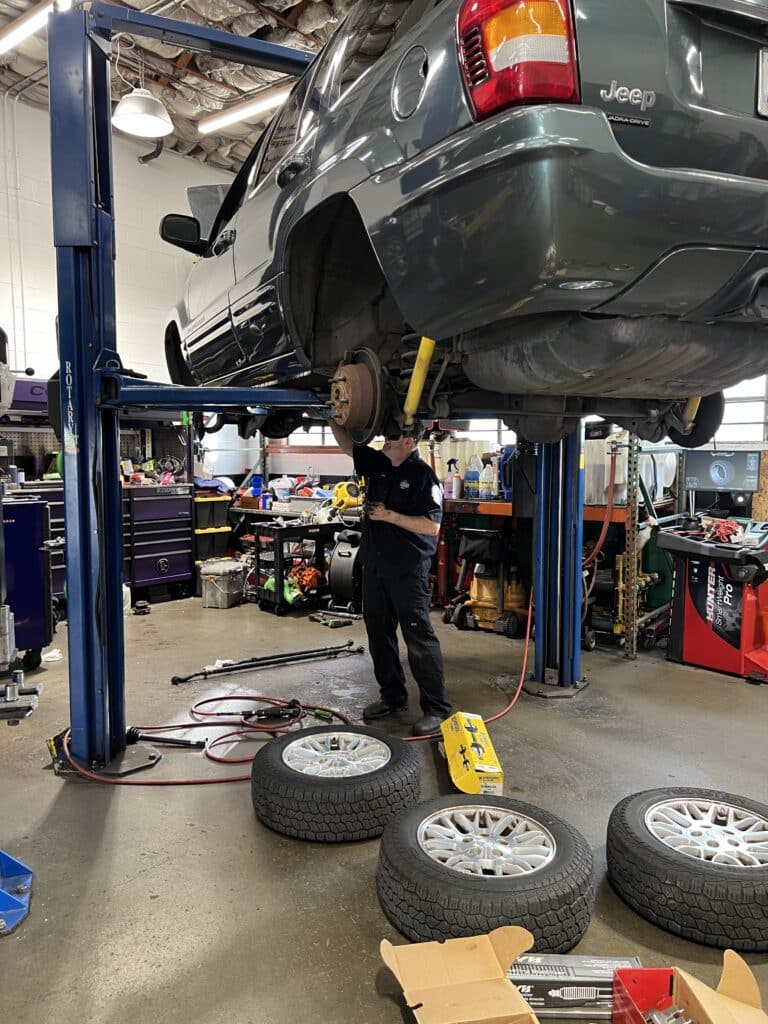
A 2003 Jeep Grand Cherokee Limited with nearly 223,000 miles recently came to 34th Street Garage for front CV axle work.
Both front CV axle boots were torn open.
The grease that is supposed to remain inside the boots was no longer doing its job of protecting the joints.
Replacing the front axles made sense.
But once the Jeep was inspected, the CV axles turned out to be only one part of what was happening underneath it.
We also found worn steering components, a noisy front driveline, uneven brake wear and other front wheel end work that needed attention.
The important point is not that one failed CV boot caused all of those problems.
It didn’t.
This was an older, high mileage Jeep with several separate wear items showing up at the same time.
That is exactly why inspection matters.
The Torn CV Boots Were the Starting Point
The original concern was straightforward.
Both front CV axle boots had torn open and had lost their lubricating grease.
A CV boot protects the joint while allowing the axle to move with the suspension and steering.
Once a boot tears open, grease can escape and contamination can get into the joint.
On this Jeep, the condition had progressed far enough that both front CV axle assemblies were replaced.
But while the vehicle was in the air, there was more to inspect.
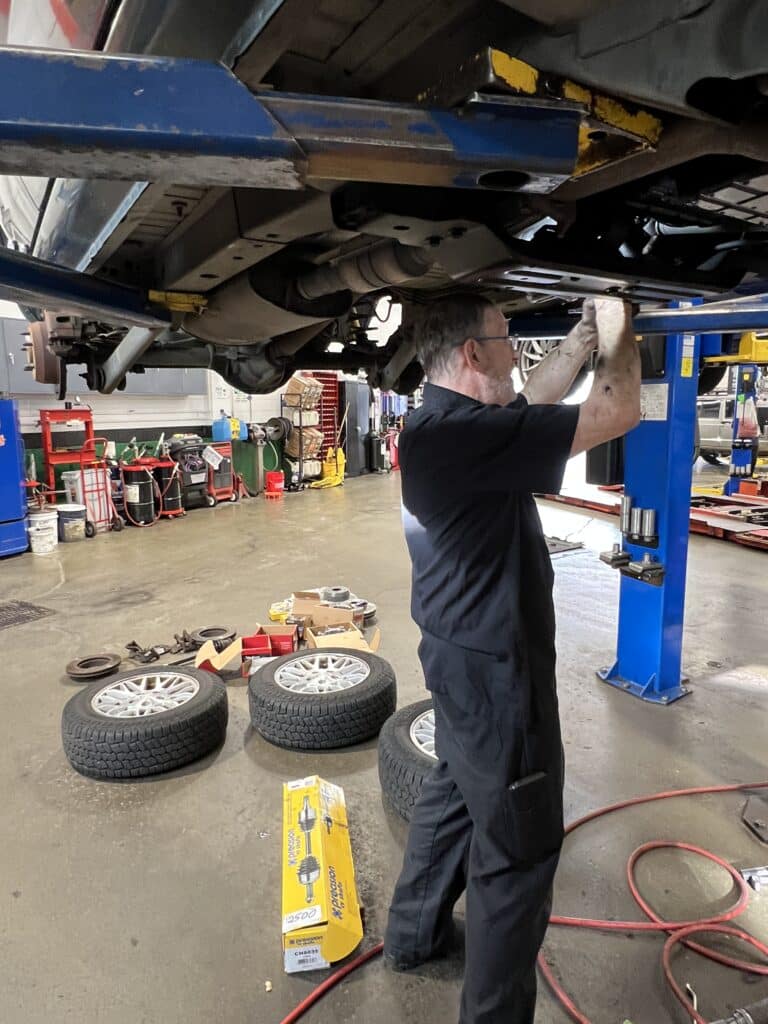
The Parts on the Floor Tell the Bigger Story
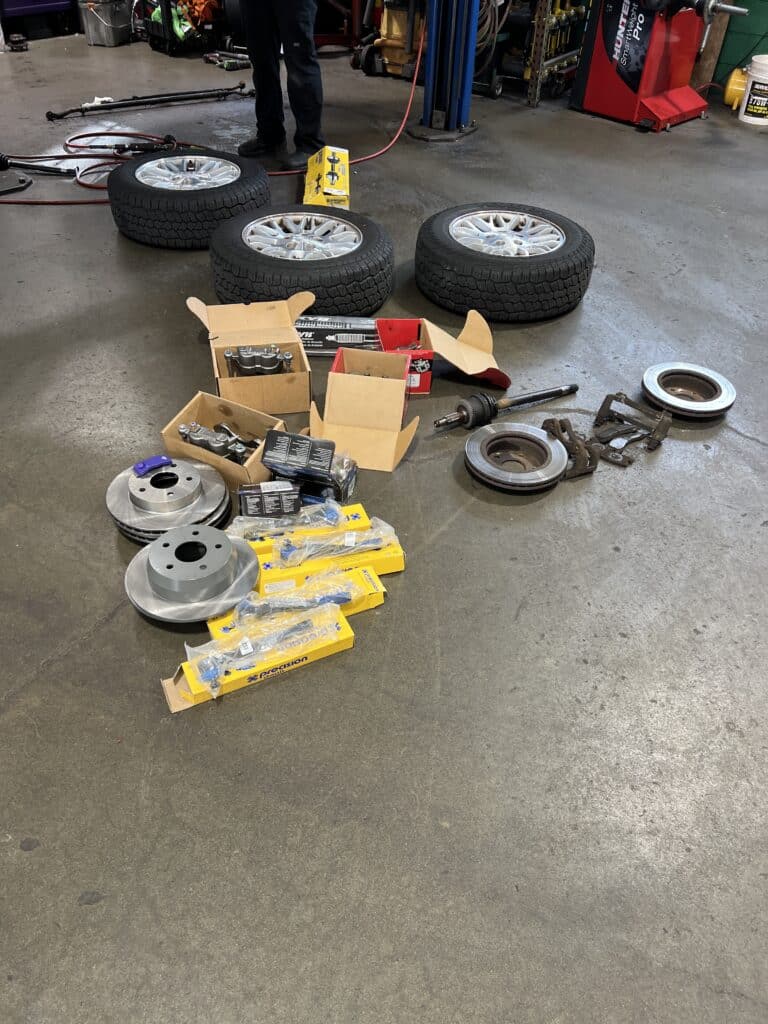
One of the best photos from this job is not a close up of a single failed component.
It is the collection of parts involved in the repair.
You can see that this was not simply:
two CV axles in, two CV axles out.
The repair grew to include work involving the:
front CV axles
front driveline
transfer case yoke
steering linkage
steering damper
right front hub and bearing
and related service work.
Again, these components did not all fail because of the torn boots.
They were separate findings discovered during the inspection and repair process.
The Front Driveline Was Making Noise Too
The inspection found another issue separate from the CV axles.
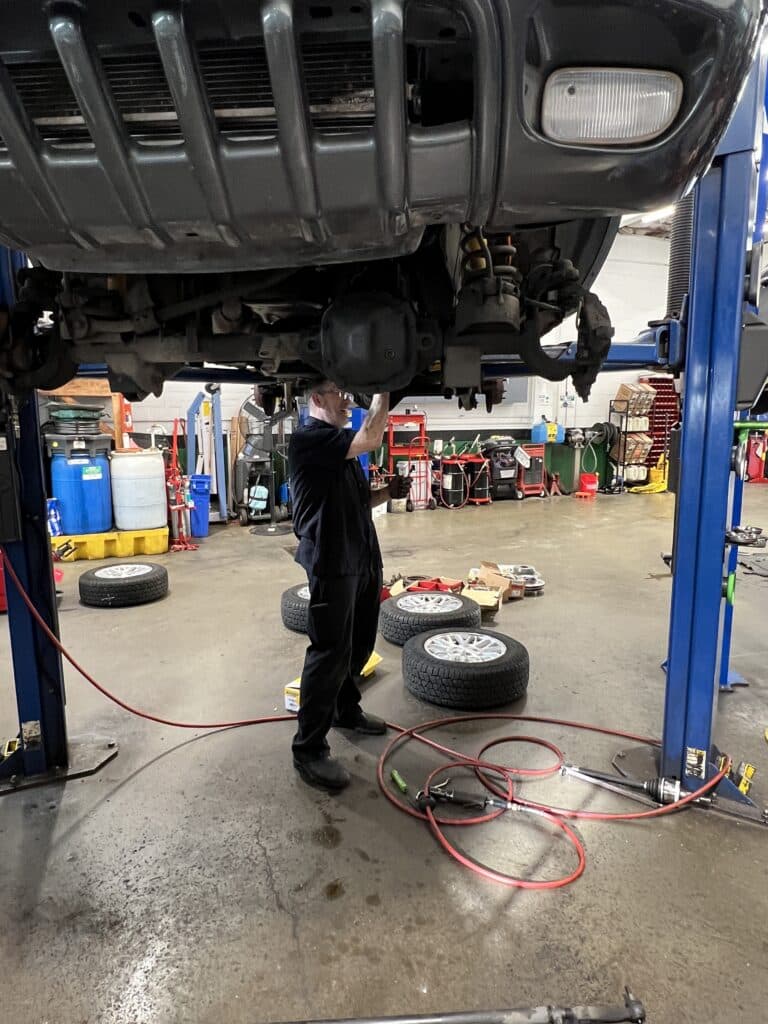
The front driveline was making noise.
Further inspection found movement at the U joint where it connects with the transfer case forward yoke.
The repair plan called for replacing the front driveshaft assembly and the transfer case yoke, along with the related attaching hardware and output shaft seal.
That matters because a front driveline problem is not the same thing as a front CV axle problem.
Both are part of getting power to the wheels, but they are different components with different jobs.
A customer may describe all of this simply as:
“Something underneath the Jeep is making noise.”
The inspection has to determine which components are actually responsible.
Steering Wear Was a Separate Problem
The steering inspection uncovered several worn components.
The drag link ends at the Pitman arm and right front knuckle needed replacement.
Tie rod ends at the front knuckles also needed replacement.
The steering stabilizer was included in the repair.
Once that steering work was completed, the Jeep received an alignment.
This is another reason we do not want to diagnose an older vehicle from one visible problem.
The torn CV boots were obvious.
The worn steering linkage was a different issue found by actually inspecting the rest of the front end.
The Brakes Told Their Own Story
The brakes had another set of findings.
The front brake pads measured between approximately 2 mm and 7 mm, showing substantial uneven wear.
The rear brakes measured approximately 2 mm to 5 mm and were also wearing unevenly.
That led to a more complete brake repair rather than simply replacing one set of pads.
The approved work included front and rear:
brake pads
rotors
and
calipers
The brake fluid was also serviced.
This is a good example of why a brake inspection includes more than asking:
“How thick are the pads?”
Uneven wear matters too.
If one pad has substantially more material remaining than another, we want to understand the whole brake assembly rather than treating every pad as if it were wearing the same way.
The Front Wheel End Was Already Apart
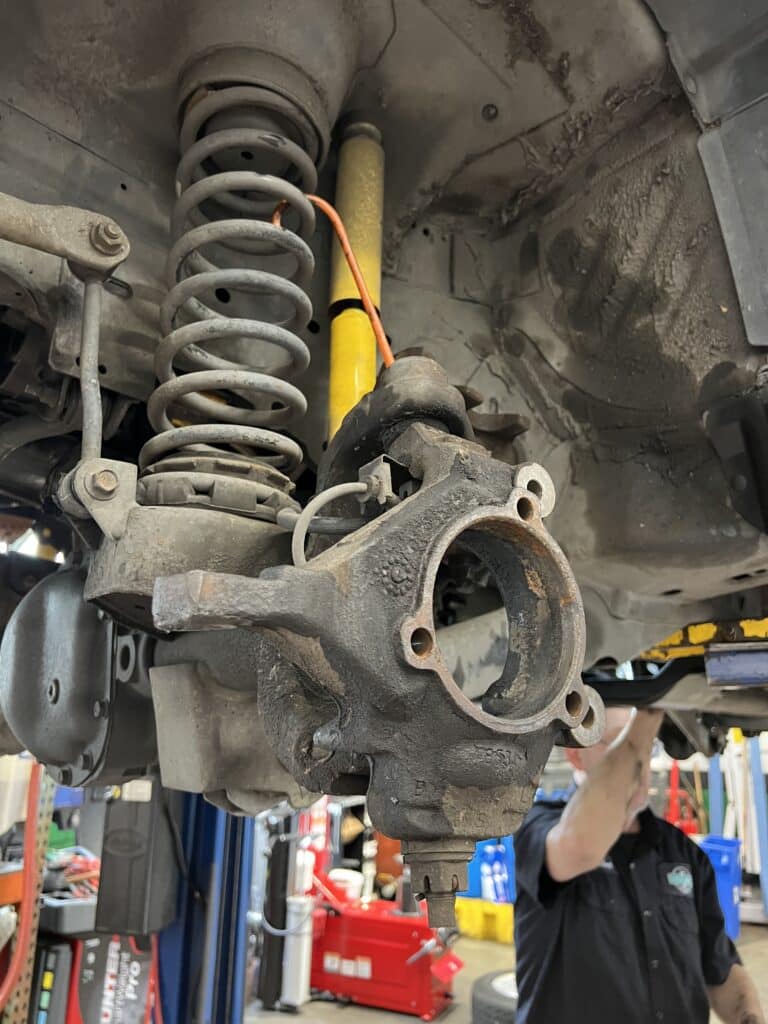
The repair photos show how far the front wheel end had to come apart during the job.
With the brake components, axle and hub area opened up, the technician had access to inspect and service the surrounding components.
The right front wheel hub and bearing assembly was also replaced during this repair.
We do not have enough source information to claim a particular noise or symptom was caused specifically by that bearing, so we are not going to invent one.
What we can say is that the hub and bearing became part of the completed repair.
Why Several Repairs Can Show Up at the Same Time
At nearly 223,000 miles, this Jeep had been through a lot of use.
That does not mean:
“High mileage equals replace everything.”
It means the condition of each component deserves to be evaluated individually.
Some components may have been replaced recently.
Others may still have plenty of life.
And sometimes several wear items have simply reached the point where they need attention around the same time.
That is what happened here.
The CV axles had torn boots.
The steering linkage had worn ends.
The front driveline had its own mechanical problem.
The brakes were wearing unevenly.
The right front hub and bearing was also replaced.
These were individual findings that became one larger repair visit.
The 4WD Fluids Were Part of the Picture Too
The inspection did not find documented recent service history for the front or rear differential fluids.
During the same visit, the Jeep received:
front differential service
rear differential service
and
transfer case fluid service
That makes sense as part of looking at the complete four wheel drive system rather than focusing only on the parts that were physically being replaced.
This is not a claim that every older Jeep automatically needs every drivetrain fluid changed.
Service history and the condition of the vehicle still matter.
Not Every High Mileage Jeep Needs This Repair
This article is about one real Jeep Grand Cherokee.
Another Grand Cherokee with the same mileage could need something completely different.
A vehicle might have:
newer brakes,
recent steering components,
replacement axles,
a recently serviced transfer case,
or none of the problems we found here.
Mileage gives us context.
Inspection gives us the repair plan.
Why the Inspection Changed the Scope of the Job
The customer already knew the front CV axles needed attention.
If we had stopped there, we would have missed other important findings underneath the Jeep.
Instead, the inspection revealed additional needs in several separate systems.
That allowed the owner to make one informed repair decision based on the condition of the whole vehicle.
This is especially useful with an older vehicle.
You do not want to assume everything is bad because of the mileage.
You also do not want to focus so narrowly on one obvious failure that other significant problems are overlooked.
The useful middle ground is:
inspect the vehicle
document what is worn
separate one problem from another
and
build the repair around what the evidence supports
What Was Actually Repaired?
The completed work on this Jeep included:
Both front CV axle assemblies
Front brake pads, rotors and calipers
Rear brake pads, rotors and calipers
Brake fluid service
Front driveshaft assembly
Transfer case forward yoke and related hardware
Steering linkage including tie rod and drag link components
Steering damper
Wheel alignment
Right front hub and bearing assembly
Front differential fluid service
Rear differential fluid service
Transfer case fluid service
That is a substantial repair.
But the important thing is why those items were there.
They were not simply added because the Jeep had 223,000 miles.
They came from actual inspection findings and the work being performed on this vehicle.
The Best Lesson From This Jeep
The torn CV boots were real.
They needed attention.
But they were only the beginning of the story.
This Jeep is a good example of why a complete inspection can matter when an older vehicle comes in for a known repair.
One visible problem can bring the vehicle through the door.
The job is to determine what else is actually happening underneath it.
Jeep Grand Cherokee Front End Repair FAQ
What happens when a CV axle boot tears?
The boot is designed to retain grease and protect the CV joint from outside contamination. If the boot tears open and loses its grease, the joint loses that protection. On this Jeep, both front boots had torn open and the complete axle assemblies were replaced.
Did the torn CV boots cause all the other repairs?
No. The brake, steering, front driveline and wheel hub findings were separate problems discovered during inspection.
Why were so many steering parts replaced?
The inspection found wear at multiple steering linkage points, including the drag link and tie rod ends. The steering damper was also replaced, followed by an alignment.
Why did the Jeep need front and rear brakes?
Both ends showed uneven pad wear. The front pads ranged from about 2 mm to 7 mm and the rears from about 2 mm to 5 mm. The completed repair included pads, rotors and calipers at both ends.
What was wrong with the front driveshaft?
The inspection found noise from the front driveline and movement involving the U joint at the transfer case forward yoke. The front driveshaft assembly and yoke were replaced.
Does every 223K mile Grand Cherokee need this much work?
No. This is one real Jeep. The repair needs on another vehicle depend on its maintenance history, previous repairs and actual inspection findings.
Jeep Repair in Magnolia
If your Jeep has torn CV boots, front end noise, loose steering, brake wear or driveline concerns, you do not have to determine which component is responsible before making an appointment.
We can inspect the vehicle, separate the different problems and explain what actually needs attention.
34th Street Garage
2410 34th Ave W
Seattle, WA 98199
206-283-3448
Visit the booking option to schedule service.